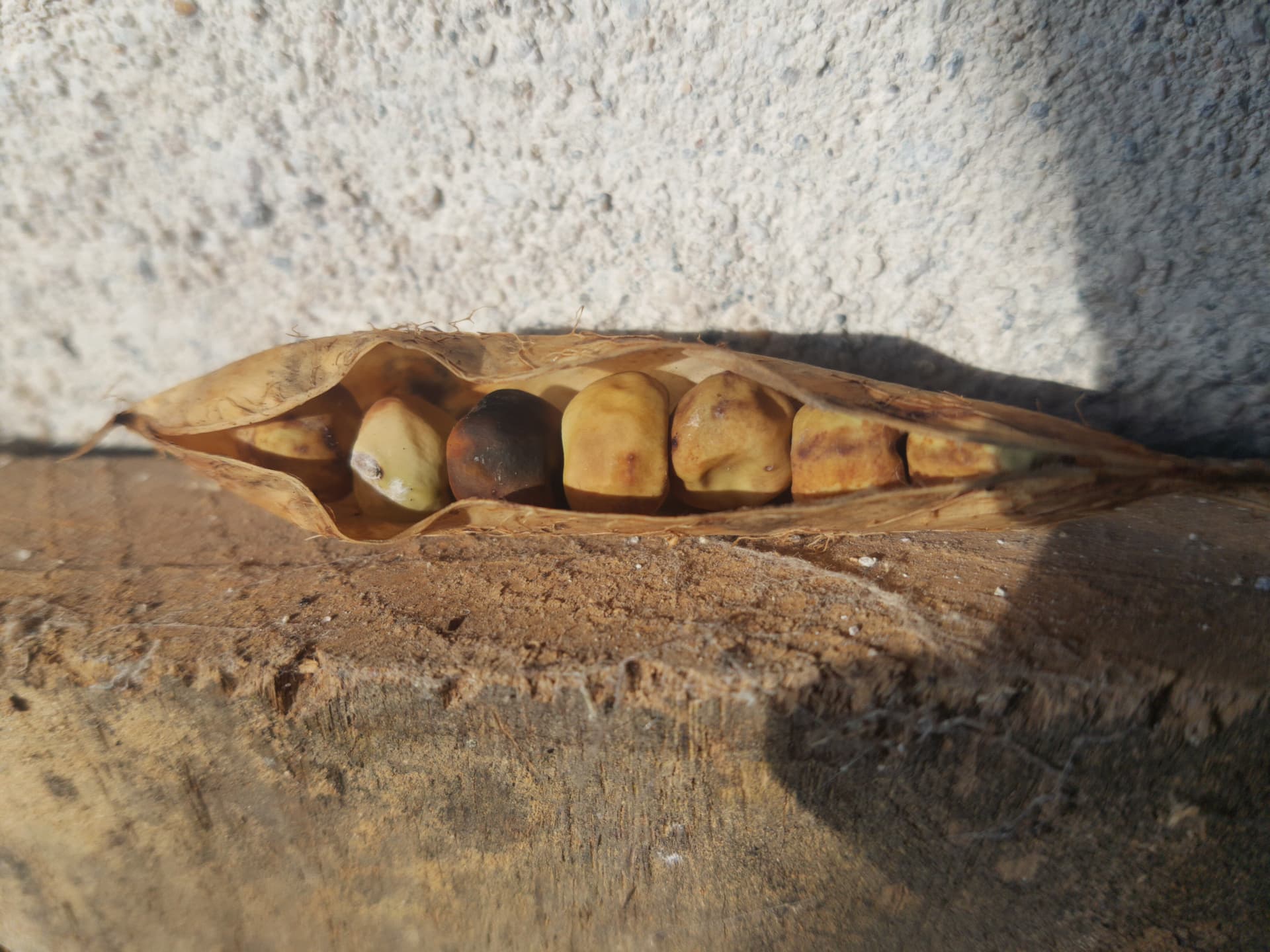
hello fava growers, just a quick update on my fava plots.
this is a grex I am conducting for the third year, with lots of seed exchanges with other fava growers (thanks!) to increase diversity.
the place I sowed them is new to me, I tried a first attempt in december but everything was eaten by birds. They have picked every single germinated seed as soon as they showed up at the surface, leaving nice and precise holes.
so when I did the real sowing, early march, I protected them with a net during several weeks, until the seedling seemed strong enough. THhis method worked well, since the net was very carefully tightenned to the ground. otherwise, the birds find their way under.
so now they are well developed, in flowers (picture)
I have 3 double rows of 6 meters, very densely sowed, since my priority is to hope for crossings more than provide food. I put 3 seeds in each hole, 20cm apart. (minus two spots with my first year peas grex)
some are attacked by aphids and I don’t know really what to do with that. so far they don’t seem to suffer. I would rather let them fight and let the strong ones survive, but I would not appreciate to loose the whole crop. So maybe a piece of advice on at what stage should I do something ? any suggestions ?
thank you jacek, I examined the rows carefully today and there are less than 10% of the plants carrying aphids, so no worries for the moment. I would love them to deal with that without any intervention from me…
I still think I planted the favas late for my Eastern Kentucky climate, but I’m starting to feel more optimistic about harvesting seeds. I can declare at this point that they have definitely done better than my first try with favas, last year.
Few plants are setting seeds, but I feel I might reasonably hope for a small handful of mature favas. Apologies for the poor focus on these images.
Nice garden of favas…all of mine died, no seed harvested. Im sure I planted them too late. Even though I recieved seed in January, our weather is on a warming trend and too hot for them. I have to wait until fall, probably November to start them…Im zone 10 Arizona. I like your trellis option, like a wall to hold them in.
@markwkidd Thanks for the photographs. I haven’t been successful getting seed from fava plants yet. I’m happy to see how they form and set the pods. I planted too late, and the temperature was too hot. I’ll try again this fall.
Something started eating my fava pods, leaving me with maturing beans on only two plants.
I made the decision to harvest the pods and bring them indoors to hopefully finish maturing before I open them. I’m excited about this harvest with the hope there will be viable seeds.
some pictures of my fava beans today. I have a question about plant height .
This year my fava are much biger than last year. The tallest is 1.65 m high and many of them above 1.20m . Could that mean that I have many crosses from previous years ? (this is my third year of grex planted very promiscuously.)
I also have questions about the “normal” number of pods per plant. It is the first time I pay attention to that, because on previous years I was just happy with any quantity of pods. This year I think I may start selecting for productivity when I harvest.
My plan is to run a first harvest, for seeds
the lower pods of all plants (for precocity and diversity)
the biggest pods of all plants (for bean size)
more pods from the most productive plants (for productivity)
Then a second harvest, for food
I will pick all the rest.
Do you think it is a good idea ? of is it too early to start selecting ? (I will have too many beans for next year sowing anyway)
That sounds good to me. I was thinking along similar lines.
My plants are also much bigger than ever before. I was thinking it is due to the abundant rain this year.
In the first picture you can see how many pods there are on my best plant. Two lowest pods I have already harvested and eaten. The plant comes from my second planting of mixed bought seeds.
This is my first year growing the fava bean mix and they’ve done so-so considering we’ve had consistent above average temperatures for the past month.
My question is about seed saving. I know we’re supposed to save seed from the earliest and tastiest, but I haven’t sampled them because it’s such a small harvest. I also have two varieties I’ve singled out simply because they kept blooming and producing with temperatures consistently in the 90s and were the last of the seeds to ripen. One consistently produced three seeds per pod while the other produced four. Seeds are small and coloring is nothing spectacular though I did originally think the 4-seed variety had bug damage but realized it was evidently just their coloration. Flowers were white on both varieties. So should I include these seemingly heat resistant varieties in the seed I return?
Due to strange and extremely slow maturing of the pods, and weather conditions threatening to return to heavy rain, I started harvesting whatever was brown enough , even not fully dry. I wanted to at least secure some seeds for next year and cancelled all my clever selection plan.
Day after day, I picked whatever was good for picking, and immediately opened the pods to put the seeds to finish drying.
Due to high humidity, some seeds turned covered with mold. these I eliminated.
I had enough dry days to push the drying properly. Not finished yet, but there will be more dry days to put them outside in the wind.
So I end up having harvested everything over a 3-weeks period. Total weigh is, about 5 kg , which I am happy with. I think I sowed half a kilo.
The picture shows the mix sowed in march (left) and the harvest (right). Of course last year’s seeds are now darker.
I don’t see big differences. Maybe a larger proportion of big size seeds. I like the color mix , which reassures me about the genetic diversity more than size criteria.
Overall I am very satisfied with this year’s production . Hopefully some spontaneous cross pollinations occurred , that will enhance this genetic pool.
The fava beans in the greenhouse failed. Outside was good. Great result thanks to you and Polarca mainly. 700 grams are the dried ones. And there is the after harvest of nicely colored ones.
The others are 300 ish grams of snow peas with a drying after harvest.
As a neighbour of your region, I recommend you try the autumn planting for fava beans (mid-October). I had done 3 sowing (October, December, March), it is clearly the first one that was more productive!
I have to plant early enough to get a crop before the heat kicks in. I’m trying for overwintering, but we’ll see how it goes. Some winters it gets below 0°F. Not for long usually but we’ve been getting those Arctic vortex effects more years than not lately.
I met a Peruvian at the seed convention in Antibes who told me they have more fava diversity there then in the Meditarranian from where it originates(!?!?!) , i have exchanged some seeds with him, see what it does coming winter. Would be nice to add some diversity to our European pulse grex. @julia.dakin and @ThomasPicard know who i mean.
Maybe i will do that, although i like the idea of snails being less active in winter and them being big and tough before they arrive hungry. He was from high higfh up in the mountains, maybe he has cold weather too? What do you think?