I nearly gave up on my TPS producing anything this year after a very slow start and most of the plants dying as seedlings. I left the three best seedlings alone but sowed a cover crop over the rest of the bed, and ironically they perked right up along with the growth of the cover crop.
One plant is blooming now and a second is forming buds but maybe a week or two behind the first, so I don’t expect to get any crossing or even viable fruits this year, but hopefully a few small tubers to plant next spring.
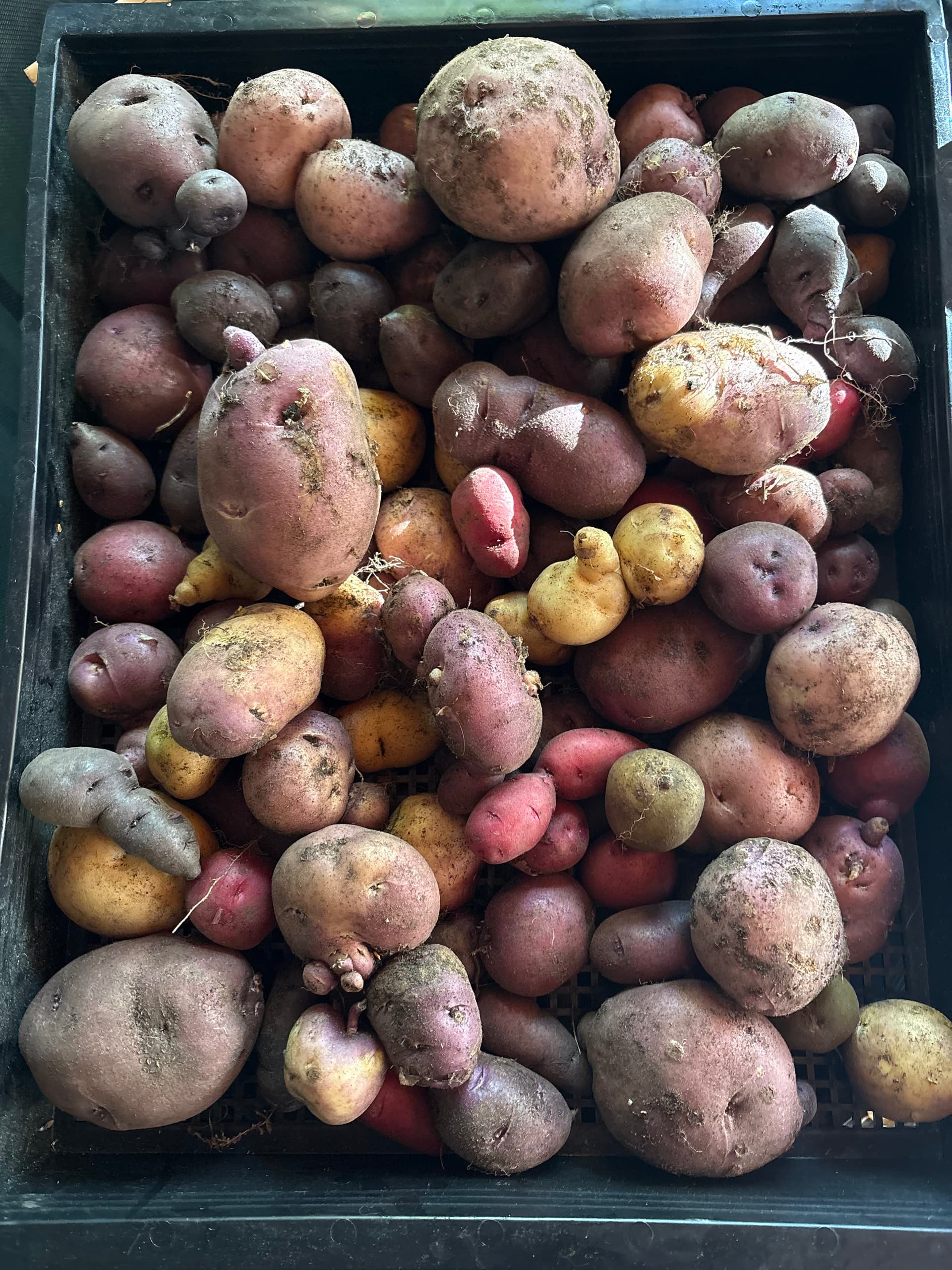
Harvest complete. Tuber selections for next year’s replant complete. Until I get gh or row covers established I will likely never get the time for the berries - future dreaming. The flowering was sparse this season in general and the majority began actually flowering late. Part of this relates to me planting them out later than I’d like due to mad respect I have for King Frost on farm and part of this quite simply goes back to seasonal extension coming down the pipe. All in all? A very successful seed tuber harvest!
Direct sown thickly in late June in zone 5a. I weeded once, never watered, top dressed with half composted mulched leaves for water retention and minor fertility in August. Compacted clay soil.
I’ve been growing G2S TPS for a few seasons now. My family has really enjoyed doing taste tests two years in a row to identify what we want to plant the following season. We learned a lot about potato flavor diversity!
My question is related to seed saving. Our potatoes hardly set seeds. Out of dozens of plants grown close together, I only got a few fruits with seed. They may have all come from the same plant, but I didn’t verify.
There were flowers, but no potato fruits in 2024. That year I had more droughty conditions, so I thought that was the cause. But in 2025 all the plants flowered profusely and I was on top of watering, the plants did not suffer at all and made beautiful tubers.
And I’m talking about robust plants grown from overwintered tubers, not first year seed grown plants.
What conditions are not present for our potatoes to set fruits & seeds? We have the diversity. We had massive amounts of flowers, a long season, and the plants were very healthy.
We are gardening in southern Oregon where the summers are arid, hot and long.
(Apologies in advance if this question was asked before!)
Thanks for amplifying my curiosity and sharing your feedback. Requiring cross pollination would make sense, assuming it’s not a temperature thing (we have very hot summers). I don’t think genetic diversity is an issue in my case because we had a bunch of varieties growing next to each other and flowering at the same time. So does that mean we are missing a key pollinator? Come to think of it I haven’t noticed much pollinator action on our potatoes (or tomatoes). We do not have a lack of pollinators though, but we are somewhat isolated from neighbors and with some forest around us, so I wonder, are we missing a key pollinator? I hope someone can shed some insight!
“The most favorable conditions for flowering and berry production are daytime temperatures in the 60s F (15 to 20 C) and nighttime temperatures in the 50s F (10 to 15 C), accompanied by high humidity. Some varieties will flower in warmer, drier conditions, but very few will flower reliably when daytime temperatures rise above 85° F and berries tend to drop early in warm weather. The length of flowering is linked to the the maturity of the variety and may last as little as a week, for early varieties, to several months for late varieties. I would expect about two weeks on average with commercial varieties. Some pesticides are known to suppress flowering in potatoes, so you might want to avoid spraying plants that you plan to use for seed production.”
I have a question about self fertile potato plants.
I thought that the self fertile gene in other plants was an unwanted one, so why do we want potato plants that are self fertile? Wouldn’t it end the same way as the tomatoes and other self pollinating plants, with severe inbreeding depression?
In the case of potatoes, it’s not really a gene that is in charge of self-incompatibility.
We have diploid potatoes which have 2 sets of chromosomes, and tetraploid, which have 4 sets.
Diploid require crossing, and are more fun in terms of colors and flavors.
Tetraploid are self-compatible, and are more productive and vigorous. Not sure about crossing rates. I’m assuming inbreeding depression can be an issue, but I’m unsure if it is an issue if you work with a varied population.
I’ve chosen to start with tetraploid because high productivity is important to me.
A quote from Raoul Robinson seems to indicate there is enough genetic diversity within tetraploids:
The modern, cultivated potato (Solanum tuberosum) is a tetraploid. That is, it has four sets of chromosomes, instead of the usual two sets that occur in the more normal diploid plants. This means that the cultivated potato cannot easily be crossed with many wild potatoes, which are mostly diploids. Consequently, amateur breeders should not attempt inter-specific crosses. All their potato breeding should be conducted within the cultivated species, but this is not a serious limitation because this species exhibits immense genetic variation.
Importantly, there is now better access to diploid TPS that could be of interest to amateur breeders, so don’t let that quote prevent you from working with those!
Also, remember with tetraploids you have more genes there being recombined. There is 4. With a simple recessive you have to keep recombining until you get all recessives. You don’t know by looking at a plant or potato if it is all dominant (ex: AAAA) or if it has some recessives (AAAa, AAaa, Aaaa). And that is only considering a single gene present.
I think diploid and tetraploid are the norm. Other ploidy happens when you do extra science lab type stuff to breed (way above my head) or in the rare instances that different ploidys cross naturally. That’s my understanding.
@KadenceLunemann and @Patate thank you for the clarification! So is it safe to say, for a home growers needs to sustain a family, it’s enough genetic diversity for me to not have thousands of seeds, and tubers, and a lab? I simply want to be able to sustain potatoes for my family over the years, probably like so many others lol
TPS are a bit more on the experimental side of seeds you can play with, but yes you can work with them with a homesteader scale and budget. It’s worth cooperating with others in your country who have similar goals.
Last year was the first year I grew TPS from seeds I got through exchange from members of the forum. I made transplants, put them in the ground in May, and added more soil around them 2 times during the season. Beatles moved into the patch, but left very quickly, with no damage. Most plants did flower but flowers fell off which was expected.
Even on plants themselves I could observe a big diversity of potatoes that were growing underground. I dug them up when the top parts of the plant were completely dry (sometimes in October), dried them in shade and stored them in a cold place that has a bit of humidity to make sure they don’t dry up.
This season, I will sow more TPS because I have leftovers from last season, but also put all the 10kg of tubers I have in the ground to multiply, and hopefully get some TPS It’s one of most exciting projects for me




 It’s one of most exciting projects for me