Beetroot was one among six crops we chose to put our collective energies in Europe for season 2026. Read more about the overall project here: Focus crops in Europe. I volunteered to facilitate the beet effort and create this thread to help coordinate among participants.
Grow more seed for the community. You can do this by receiving genetically diverse seed from the community, grow it out and allow the best beets to set seed.
Raise the bar: Make more adaptive and delicious beets - by increasing genetic diversity, local adaptation and organizing tastings. Help by sourcing interesting varieties, grow them out and allow them to cross-pollinate, so we get beet grexes to build on. We decided to make a beet grex - join the effort here.
Documentation: Create stories of success and failures with adaptation (pictures!) that are closer to home and thus more relatable for our immediate communities. Generating data that can be used as proof of concept can also be very helpful. Grow adaptive seed on one row and then some named varieties right next to it - take pictures of how they grow over the season. For people who struggle growing beets, this is your chance to put genetically diverse seed to the test.
Create a focus and resource for new members. It’s more fun to grow together!
I will keep this top post as a continuing resource to edit, for example with overview of current breeding of beets, interesting seed sources, potential breeding goals, fun facts etc. as they come in.
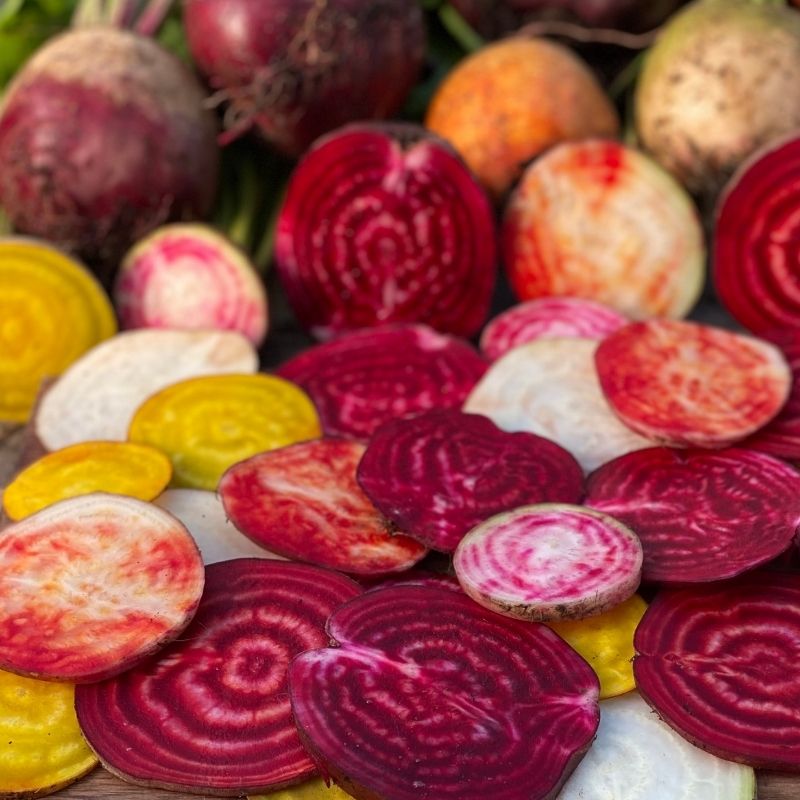
An example of the genetically diverse Evansville Ember Beet created by beet breeder Solveig Hanson. Potentially valuable seed to use as breeding material?
I love beets because they are so hassle free: I can toss some seeds anywhere and they’ll grow. Then I can keep them in the bed through early winter without having to worry about storing them correctly. And then I can make the most delicious beetroot salad and even that stores super well and is the perfect meal prep salad.
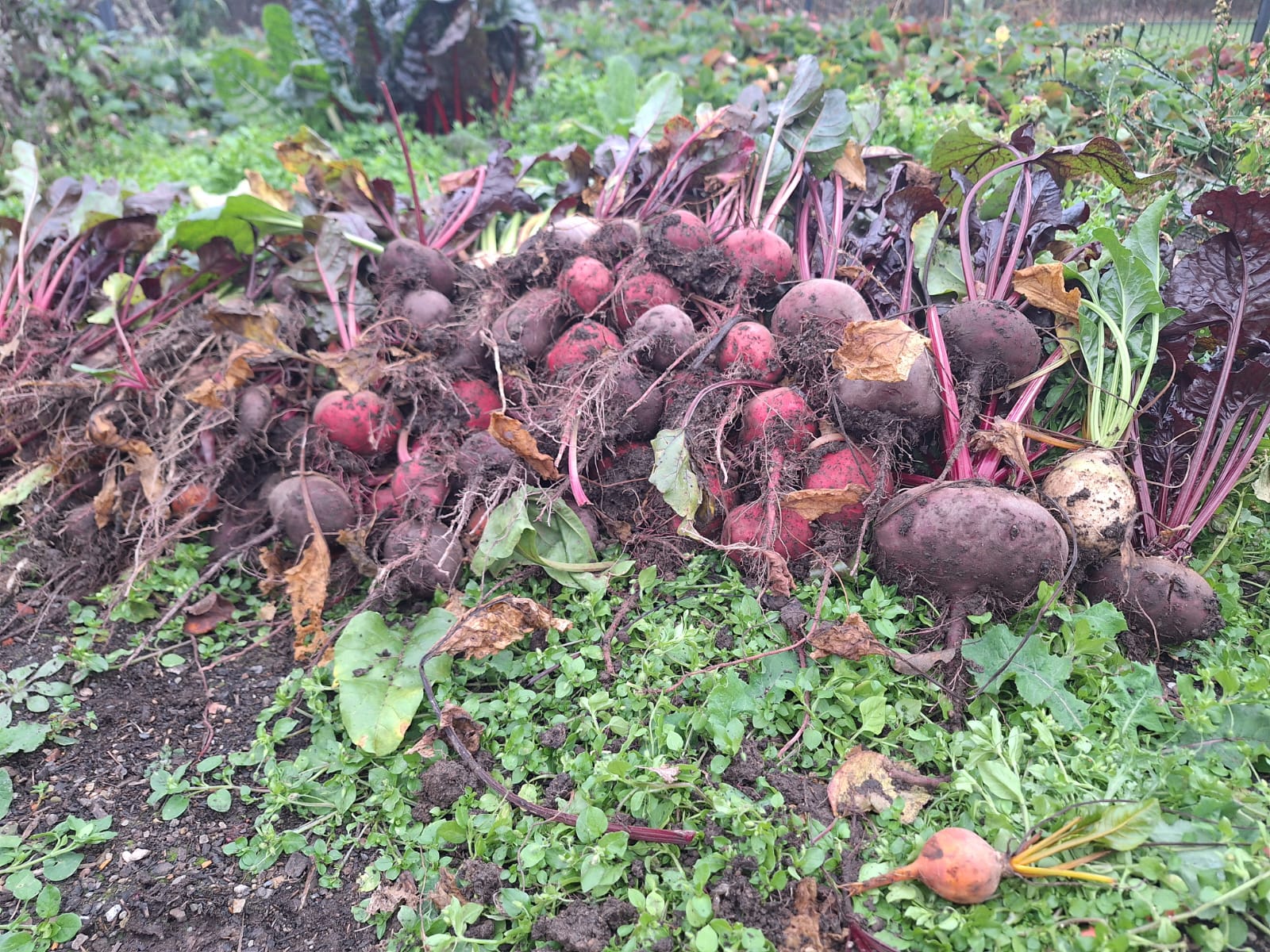
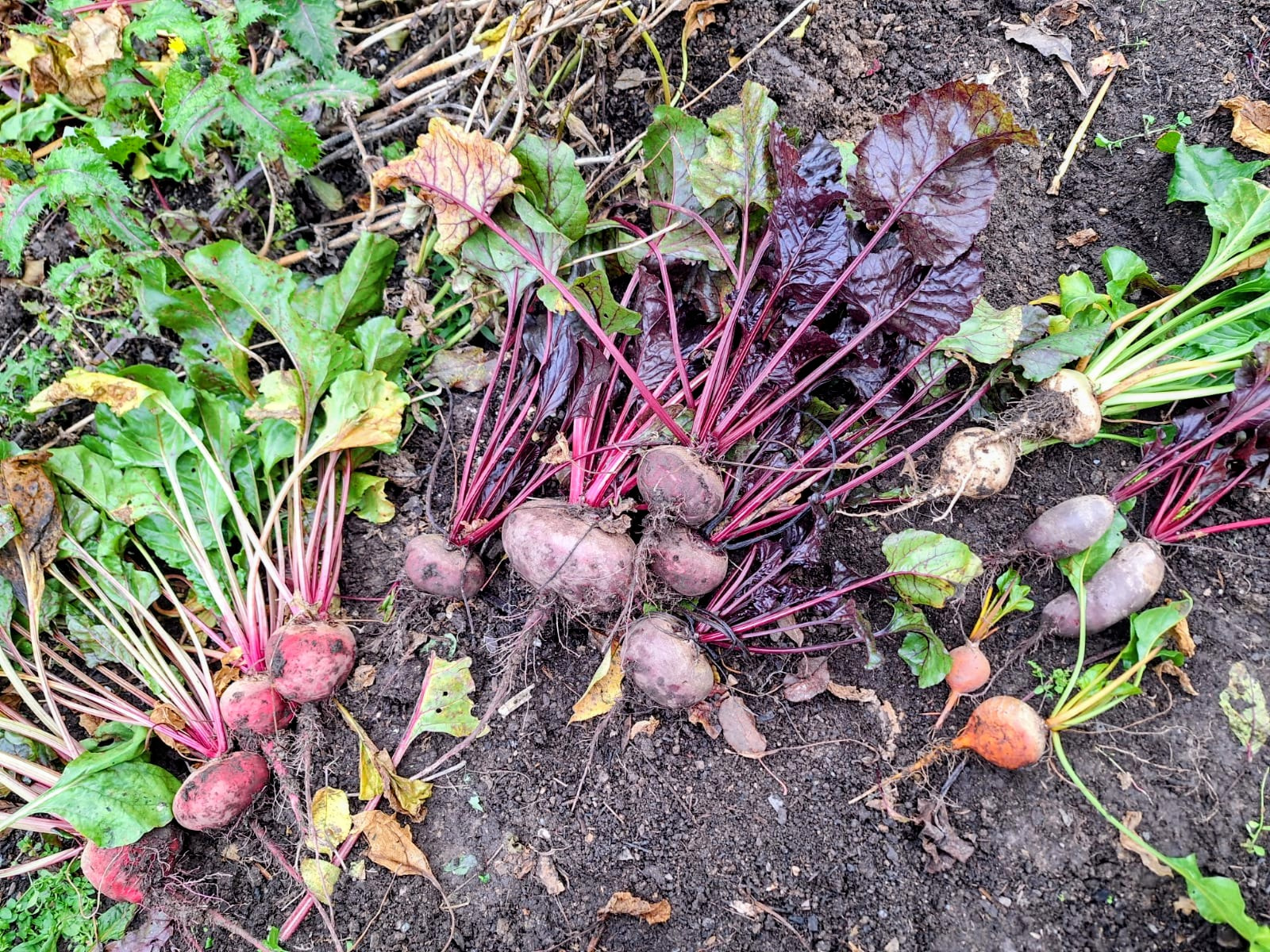
This year I grew a mix of different varieties from Bingenheimer: Ägyptische Plattrunde (=D’Egypte I believe), Tondo Di Chioggia, Forniro and Wintersonne (=Wintersun). Pulled them out for evaluation last weekend:
Despite being only four varieties, I found a fifth phenotype: a couple of white beetroots. Not sure where that came from, maybe the yellow variety was not fully stabilized (yay!).
I especially love this one: So big, despite me sowing them quite (maybe to) thickly and not thinning out.
Resistance to slugs and heavy soil are two goals I could totally get behind!
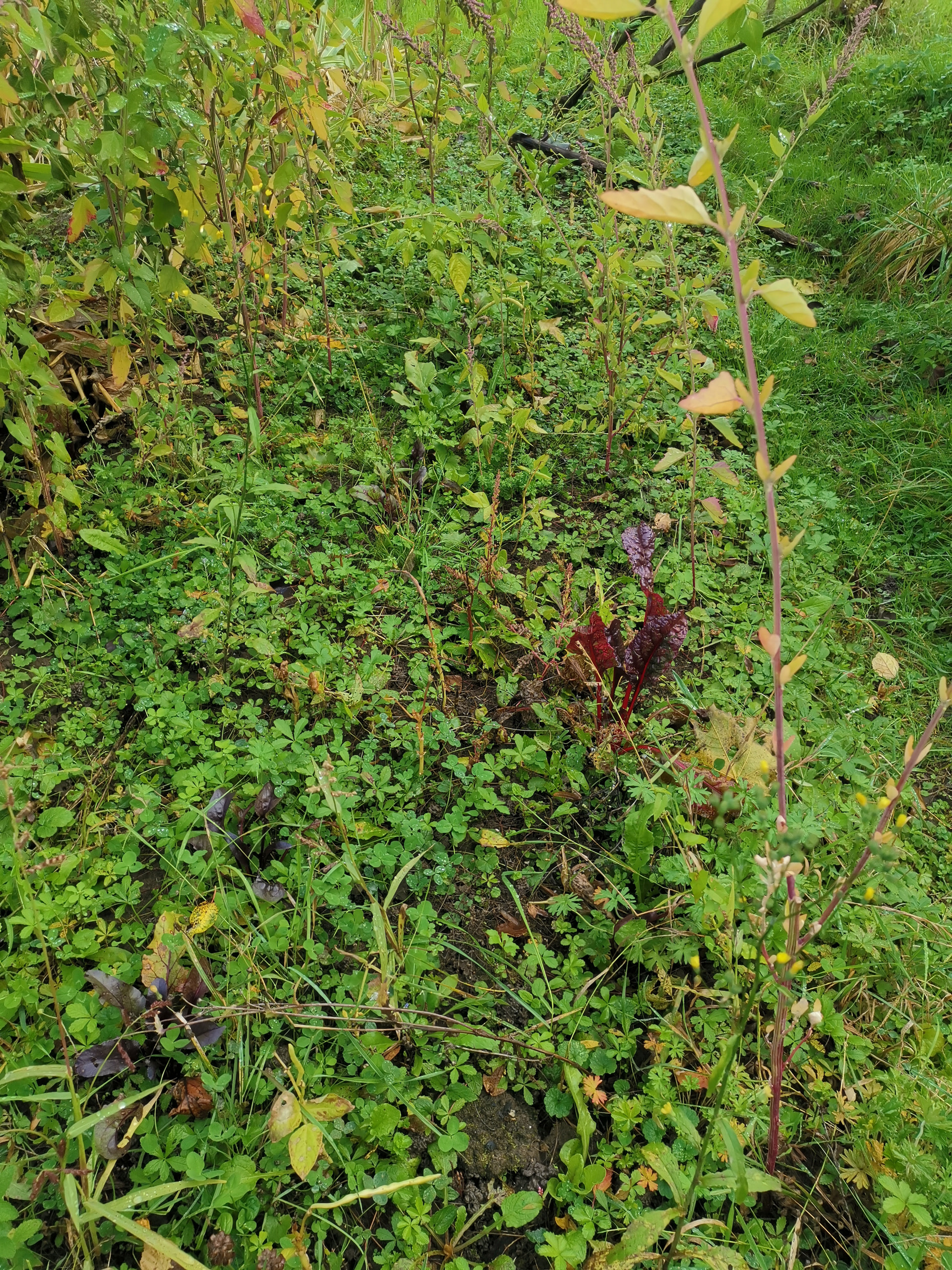
I noticed a huge difference between different varieties with my heavy soil, while some really thrive, others (especially the elongated ones (like Formanova) seem to struggle a lot. A vigorous landrace that consistantly makes big beets under these conditions would be ace
Nice to see participants sharing stories about their beets. You can read about my beet project so far here: Long Colorful Beets for flavor.
I’m still learning a lot about the potentials in beet, so I’m interested in focusing on genetic diversity, before my own criteria get more specific. And I think that our wider community in Europe could benefit a lot from having seed with higher adaptability, so I’d like to put that front and center.
Making a grex together
A place our community could begin raising the bar with beets is to make one highly diverse grex that all our members could benefit from. To my knowledge, I don’t think we have such a thing. Are you up for making that one of our projects?
This winter we could acquire as much diverse and interesting beet seed. We buy the seed and have it sent to one of us. That person mixes the seeds and then send individual packets to all participants. The coming season, we grow that mix out, perhaps along with any GTS-grown seed we already have. At the end of the year, we save a decent amount of beets to grow out for a cross-pollinated grex in 2027. Half of the seed, each individual growers keep for themself (as there was already some local adaptation when the initial mix was grown out), the other half is sent to one person, who once more mixes all the seed into a highly diverse GTS beet grex.
This doesn’t prevent us from doing other things together to increase our seed and raise the bar, e.g. I assume several of us have already roots stored for growing to seed in 2026 that we can also focus on pooling at the end of the season.
What do you say?
Turning on notifications
We are currently 8 participants in the beet group: @mare.silba@malterod@Bore, @Saskia, @jackpeppiatt, @Jacek, @Anita Great! To help us work focused together, I suggest turning on notifications for this thread by default. You do that in the lower right corner. It’s up to you of course, whatever works to get you tuned in.
Some things I’ve learned about beet breeding that might be useful and could be built on:
Beets are wind pollinated, have hermaphroditic flowers and is out-breeding. It has a self-incompatability mechanism where the male flowers on a plant develop before the female flowers, so called protandry, ensuring that crossing with other individuals will happen.
Swiss chard, beet root and sugar beet cross-pollinate - they are all the same species. The lesser known “Perpetual spinach” (AKA Erbette) is also Beta vulgaris and will cross with beets.
There’s currently very little commercial breeding work done on beets. One challenge is that modern breeding methods demand isolation which means pollen-secure conditions with filtered air. Primary breeding methods are still mass selection (similar to what many of us do) and family selection (a bit more involved, where seed is saved separately from each individual root to then be grown out in individual rows).
Flowering needs cold temperatures minimum two weeks at 4-10C. Some breeders with long seasons take advantage of this by growing beets out early in the season, dig up roots to select the best, then put them in the fridge for two weeks, plant them out again (still same season) and allow them to flower and set seed. The technique is called vernalization and can be used when breeding many biannual roots.
The visible “beet seed” is actually a cluster containing containing 2-6 seeds in each. Under decent conditions they keep 5-10 years. This is important for our grex project, because it means our community could benefit from it for several years so new members can adapt beets to their location from it.
A bit of work is done on cytoplasmic male sterility (CMS), but it is mostly in sugar beet breeding and seems to not be widely adopted in beet breeding.
Color of beets. Come from a class of pigments called betalains common to other plants in the same order that beets are in (Caryophyllales) like amaranth, cactus etc. The two types are β-cyanins, which color red to violet, and β-xantines, which color yellow to orange.
The wild ancestor is Sea beet (Beta vulgaris subsp. maritima). It is found on sand beaches, pebble banks, coastal rocks, cliffs and saltmarshes along the European coasts from Scandinavia to the Maghreb all the way to Southern Asia. Crop history assumes that it was grown first as a leaf vegetable in Southern Europe, so the Swiss chard form is the most ancient. Only later when northerners started selecting for larger storage organs to keep over the winter, the beetroot appeared. Sugar beets came last when Europeans in the mid 18th Century explored a domestic source of sugar as an alternative to sugar cane from the American slave plantations. There’s another wild subspecies in the Western Mediterranean called Beta vulgaris subsp. adanensis.
I have grown beets for many years and love to eat them in any way. But I have never grown them to seed before. Wanting to change that I have some roots stored frost free in moist sand and also left a few in the ground covered with mulch (hedging my bets). It’s three elongated red varieties that I really love and that do reasonably well in my sandy soil. I have very mixed results with beets in general; some do okay, others hardly grow. I would gladly benefit from this group project to find beets that are dependable for me.
I have no source for especially interesting beet seeds for the 2026 season but can definitely get a range of varieties from good seed sellers in the Netherlands (Vreeken, De Bolster) and Belgium (Kweek) to contribute to the project collection. And I’m happy to make space for growing out a beet grex in 2026.
@Malte: I’m curious about what you wrote about the possibility of speeding things up. By growing out beets early, putting them in the fridge and planting them back so as to have seeds the same season. I wonder if I could manage that in the Netherlands. Earliest sowing is mid-March, then I could perhaps put the chilled roots back in the ground to flower mid- to end June. Do you think that might work?
I don’t know, but it could be worth a shot and, right on target with the goal of the project, we might all learn something about beets in our context. If you’re willing to give it a shot next season, I think it’s a great project!
Bumping this to see if there’s any interest. So far no replies. Does this mean people would rather do something else than making a grex together? I’m curious what those of you who signed up for this focus are interested to do.
Hi Malte, I missed your post. Thx for bumping it. I’d be up for the proposed grex making. It sounds a little more interesting than when everybody just grows their own seed.
I think it’s a very good idea! Although my personal contribution to the grex would be limited to a number of regular open pollinated seeds from good seed sellers in the Netherlands and Belgium. No beet seeds of my own as yet.
That was my general idea: Everyone just help source as many different seeds as we can, send them to the same address (I can volunteer), mix them all up and send out individual packages to each contributor. That way we can pool our resources and get some benefit of genetic diversity already this year.
If with ‘more seeds’ you mean beet root seeds, yes. This project is all about beetroot, not swiss chard. Is it perhaps the case that you misunderstood and signed up for a project you didn’t want to work on? Just let me know and I can pull you from the list. It will make it more clear for us all who is taking part and who is not.
Untill when would you need to recieve the seeds? When do you guys sow beetroots?
Some time in early March we will have a seed fair / seed exchange in the botanical gardens in Bonn. That would be an opportunity for me to look for seeds.
Otherwise I’m now a member of the VEN (Verein zur Erhaltung der Nutzpflanzenvielfalt), so I will just order some seeds from the VEN beetroot group and send them to you.
I might also be able to get some Polish commercial seed if it’s of any interest.
Where I am, we sow beets from April to June, so there’s time to find as many different seed sources as possible. I think to make it simple, the goal for us as a group could just be to work together to get as much genetic diversity as possible. That is, we don’t try to get certain varieties with certain traits. Just try to get as wide genetics as possible. For example, bringing in genetics from Eastern Europe or USA could potentially be valuable for Western Europe, because it is mostly the same German, French, Italian varieties where I am. My understanding is that genetic diversity is primarily dependent on geography at the moment.