I have saved seed from beets I’ve selected for taste since a year or two and want to document my journey here.
My criteria are:
Fast-growing. I want them to quickly compete with weeds. If I want small beets for some reason, I can just harvest them earlier at that stage. If I want large beets, I just wait. When I save roots at the end of the season, I will thus select the biggest ones, assuming they were the healthiest and fastest growing.
Flavor. To be explored more. Beets have a polarizing “earthy bitterness” that some like and some don’t. I wonder if there is a part of that earthiness that could be decreased while containing the part of it that makes beets interesting and not just sweet.
Rainbow colors. I love them in all the colors: yellow, red, striped, white and my chef students especially love the combinations of them like Chioggia beets with a lighter pink red instead of white stripe.
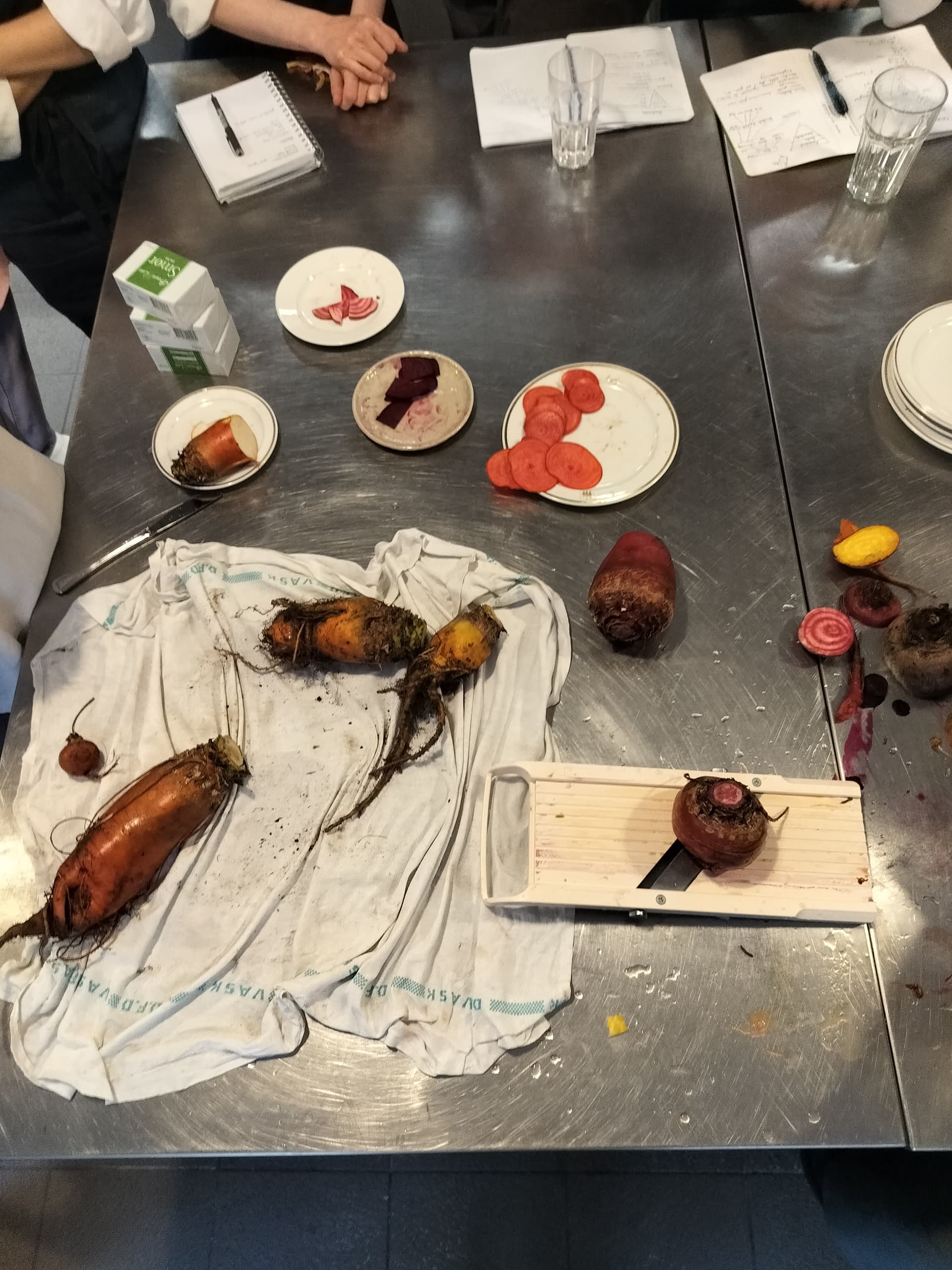
First year of selecting for flavor with students. We did this really ad hoc in September 2024.
The most important learning I had was a bit embarrassing in hindsight: Remember to peel the beets before tasting! We discovered that bitterness really sits mainly in the peel of the root. After tasting more than a handful of beets with peel, you start to get a slight burning sensation in your mouth that is not very pleasant. (I am grateful that I did this test with 1st year student)
One thing I did right, which I learned from tasting carrots, is to use a mandoline. You can make lots of thin slices so more people can taste and still save a sufficient amount of the root for seed if it passes the test.
Next learning is that while raw tasting can give you supplementary insight, it really does make sense to lightly cook the beets before selecting for flavor. 95% of the time, we will use beets cooked. And in the other cases, they will almost always be “cold cooked” by some kind of acid as when you put them in vinegar. So next time, I will slice beets and then steam them for about 5 minutes in the oven, before tasting.
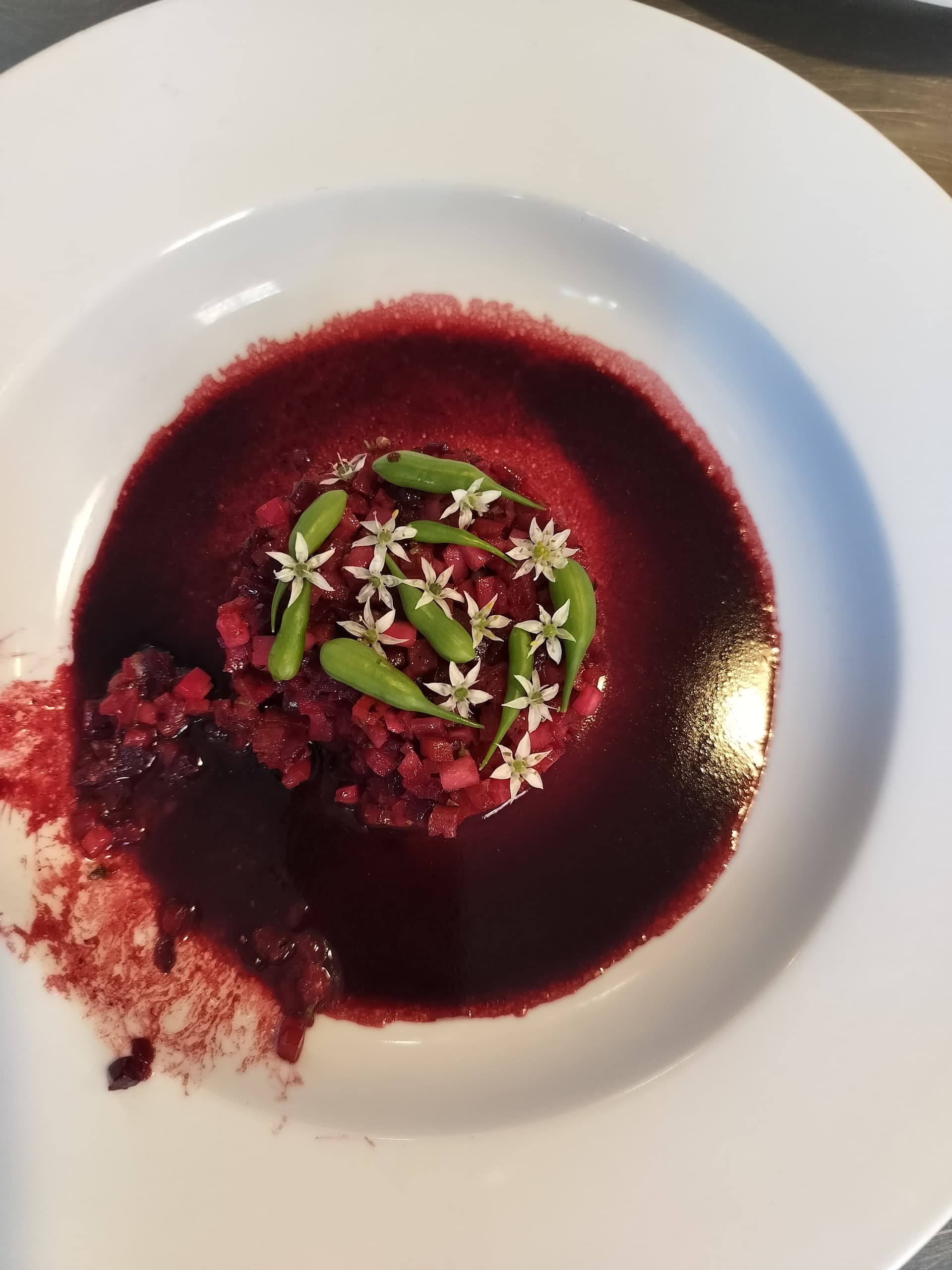
Of course, the students have to finish it off by getting creative and making a dish of their own design where beets play a central role. This is always very fun and after talking and tasting roots for an hour, they have lots of ideas.
One student finished her first half year of chef school by saying that this was her favorite day of the entire course and she instantly went home to buy more beets and book with them in her kitchen. I love this story!
Out of interest, did you leave them in the ground to go for seed next year? Your winters are so much milder than mine that it seems like most obvious choice. I’m not sure how they would survive here and last years the survivor plot, where I could leave them in the ground, they haven’t grown so haven’t really been able to test it. But storing them over winter also failed (they were alive, but didn’t establish) which is why I’m interested if you stored them or overwintered in the ground? Next year I gotta try with the seeds that I have in the same area where I had carrots grow well to see if big roots would overwinter. If it’s successful I could piggy back on your work the next year. Beets is one of my favority root vegetable by taste and it doesn’t have really any other problems than animals very much like to eat it too. That’s just matter of fencing or covering. Just keeping them alive over winter is whats holding me back.
I saved the best beets from 2024 to grow for seed and had some big, beautiful inflorescences coming up in the summer that soon after got repeatedly eaten by wildlife, I think esp. deer. This is my first year growing at this new location and I have been spoiled by fences. The deer seem to particularly like the above-ground part of my beets, incl. all the Swiss chard that failed for that reason.
I probably got measly 10-15 seeds, all of them pretty small, at the end of the season.
As for growing, while the deer also ate the leaves of the beets throughout the season, I was surprised to get a crop in spite of that. They are far from large! But they seem to be able to pull through and some roots have potential.
Started in spring in plugs and planted out 30th of June. Harvested these 20th of October.
Personally I think some are even too sweet (hence sugar beets have been bred from them). Especially the white fleshed seem too sweet without any other flavours. Suppose I like the earthy flavour, although I don’t see it as earthy that much. Just good beet flavour.
Out of interest, did you leave them in the ground to go for seed next year?
Yes, I did just replant them shortly after taste selection, so October last year. I made sure to cover them a little bit, but expected a few of them might die from frosts. Usually, enough of them survive.
This year I might overwinter them frost-free in a shed at least for some of the winter because there might be a tractor going through the field to dig up some bushes.
I am also considering to replant the beets somewhere that is safe from deer pressure. Of course, as you say, I could also just make a small fence around my “seed garden” area.
I have searched for contemporary plant breeders of beetroot to learn more about this crop. I discovered that not much seems to be happening in beet breeding. Irwin Goldman has done some important work and he also created the Badger Flame Beet, which inspired me to begin this project in the first case.
Where does the earthy flavor of beets come from? Goldman’s team isolated the compound geosmin, which is primarily produces by streptomyces bacteria in the soil (when you smell freshly plowed soil, that’s geosmine), but some plants also make it themselves - beets are one of them.
Beets also have tremendous potential to make sugars, proven by sugar beets.
My takeaway from this so far is that selecting for flavor means dealing with two main factors: (1) sweetness, (2) the relative presence of geosmin (earthiness).
Alan Kapular has developed a couple of interesting beet grexes with larger than average beets. If I didn’t have too many other projects going, I would be playing with them.
I have tried to landrace my beets but I live in wild swisschard territory and that pollen is really light. Also, because I’m selecting for multi annual/perennial chard and have had consecutively flowering individuals for the last years, I feared cross contamination and ended up always pick the beet before they flower.
I am hopefully going another route if I manage to get viable seeds from a triploid yellow that came out of three root grex (also had a triploid shiraz but perished)… didn’t flower this year because I sow them too late in 2024, but next year I think I might have some seeds.
But, regarding breeding lines for a project like yours, some considerations: Touchstone Gold has very little earthy flavor. Also, very nice internal color and doesn’t stain. Cylindra’s shape is very interesting for Chefs because it produces a lot of slices with the same size. Shiraz really stands out in a market stand, very uniform roots and upright “bunchable” tops. Three root grex has amazing vigor and some of that Kapuler mojo.
There is a yellow grex that he made himself from Lutz Green Leaf, Crosby Egyptian and Yellow Intermediate (the Long Island Seed Project references it). There is also a yellow-only selection that Fedco made from 3-root grex. I’m having trouble finding seed from the former now that the latter is out there.
If I were working on beets, I would include 3-root grex and add other red selections to it to hold it towards those bolder flavors. I’m pretty sure this is an effect of growing up on my grandma’s home grown-home canned pickled beets.
Great ideas. I already have some Cylindra genetics in the pool and plan to incorporate more. That variety comes from my own region too and I really like the shape of it. My ideal image is something close to that shape for exactly the reason you say. You can put it on a mandoline and cut lots of slices. Long smooth types, some chefs also prefer because they are easy to clean.
The triploid beets you discovered, how did you know they are triploid?
The yellow grex containing Lutz Green Leaf etc. you’re referring to is it different from 3 Root Grex? 3 Root Grex is based on the same three varieties.
The Fedco selection I believe is called Golden Grex Beet - I got it through EFN.
I haven’t had the chance to compare the flavor of 3 Root Grex to other beets. Do you prefer it over others or why do you like it?
nothing like saving seed and sowing it next year… if all of the progeny has three cotyledons, I might be on to something.
EDIT
Just found out about this… so even if by Thor’s miracle my plant was actually a triploid, by Zeus’s miracle it managed to produce a chromosome doubling generating hexaploid viable seed and finally by Tlaloc’s miracle I managed not to let them die by dehydration… they could still be pollinated with the wild chard population I have around my place…
I’m trying to understand exactly what you are referring to. Your first link is to a chatbot-generated answer to my question. Did you check whether the studies referred to actually exist and if so whether they actually provide evidence to the matter? We know from studies that chatbots invent things that sound like fact, but are very bad at actual facts. BBC recently did a survey that found significant mistakes in 51% of all answers.
Chatbots regularly produce nonsensical answers like the following and the only way to know that it is nonsensical, is to have some knowledge on the field. How do you know that the above linked chatbot-generated answer on Google doesn’t contain similar nonsense?
This is a good example of my point. In your Google AI summary, it says that “the ploidy level is consistently diploid”. But in the actual article, you just have to read the top abstract to find the quote: “The analyzed populations were mostly [emphasis added] diploid, except for one population of B. vulgaris subsp. maritima that presented both diploid and tetraploid individuals”.
Harry G. Frankfurt once wrote a short book about bullshit, which he defined as speech intended to persuade without regard for truth. LLM-bots don’t have a reference for truth, but can only guess on which next word would make its sentences seem persuasive. Thus, they fit this definition. I get bothered by the tremendous noise generated by chatbots and would prefer, please, if they are not used to clog the communication channel in this thread.
I found a very interesting article on beet flavor by the team referenced above (Irwin Goldman, Solveig Hansen etc). It is perhaps the first participatory plant breeding study on beets!
I will read it more thoroughly later, but found some surprising facts already:
Geosmin concentration is not the central factor determining whether people in their study (chefs, farmers, CSA members) like the beets.
People didn’t even experience high geosmin beets as more earthy. They didn’t find a relationship between geosmin and earthy flavor.