Has anyone tried crossing Common Beans (Phaseolus vulgaris) x Runner Beans (Phaseolus coccineus) x Tepary Beans (Phaseolus acutifolius)? How epic would a tri-species landrace be?
I’m thinking the high heat & drought tolerance from tepary genetics combined with Huge Runner Bean size & Diverse Pod colors from Common beans would be the most epic landrace ever!
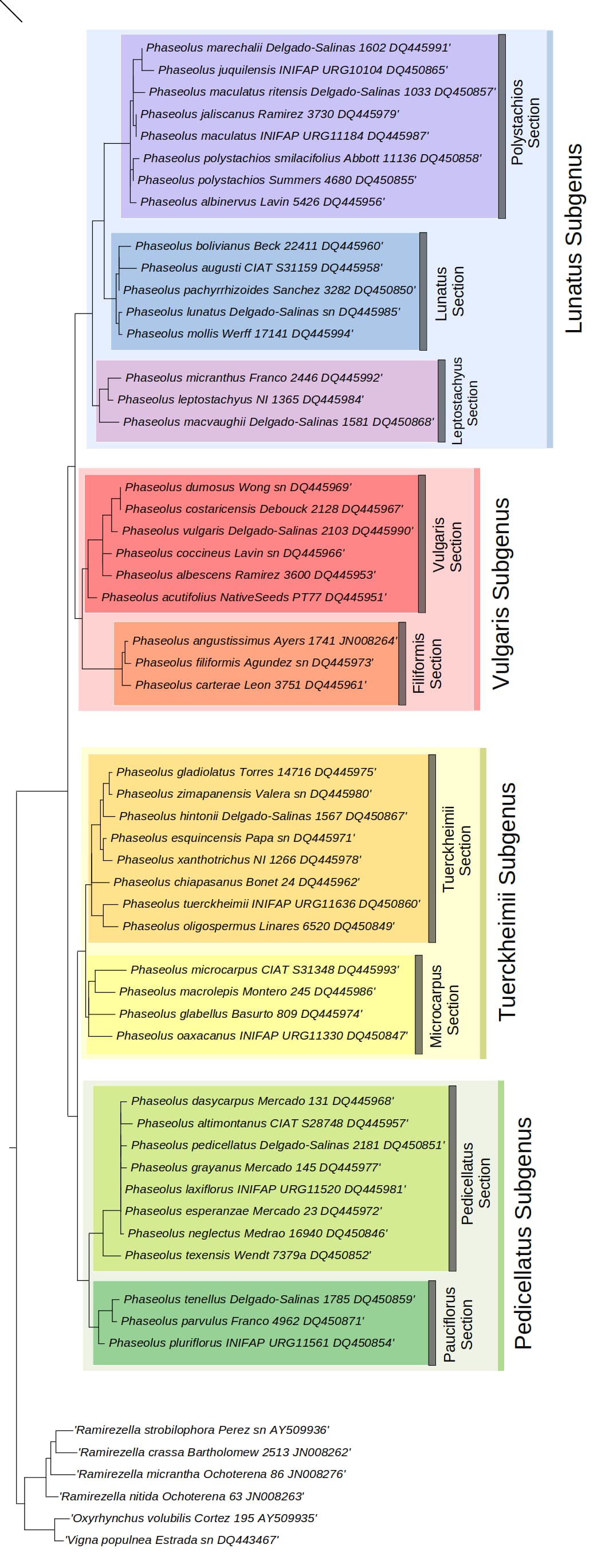
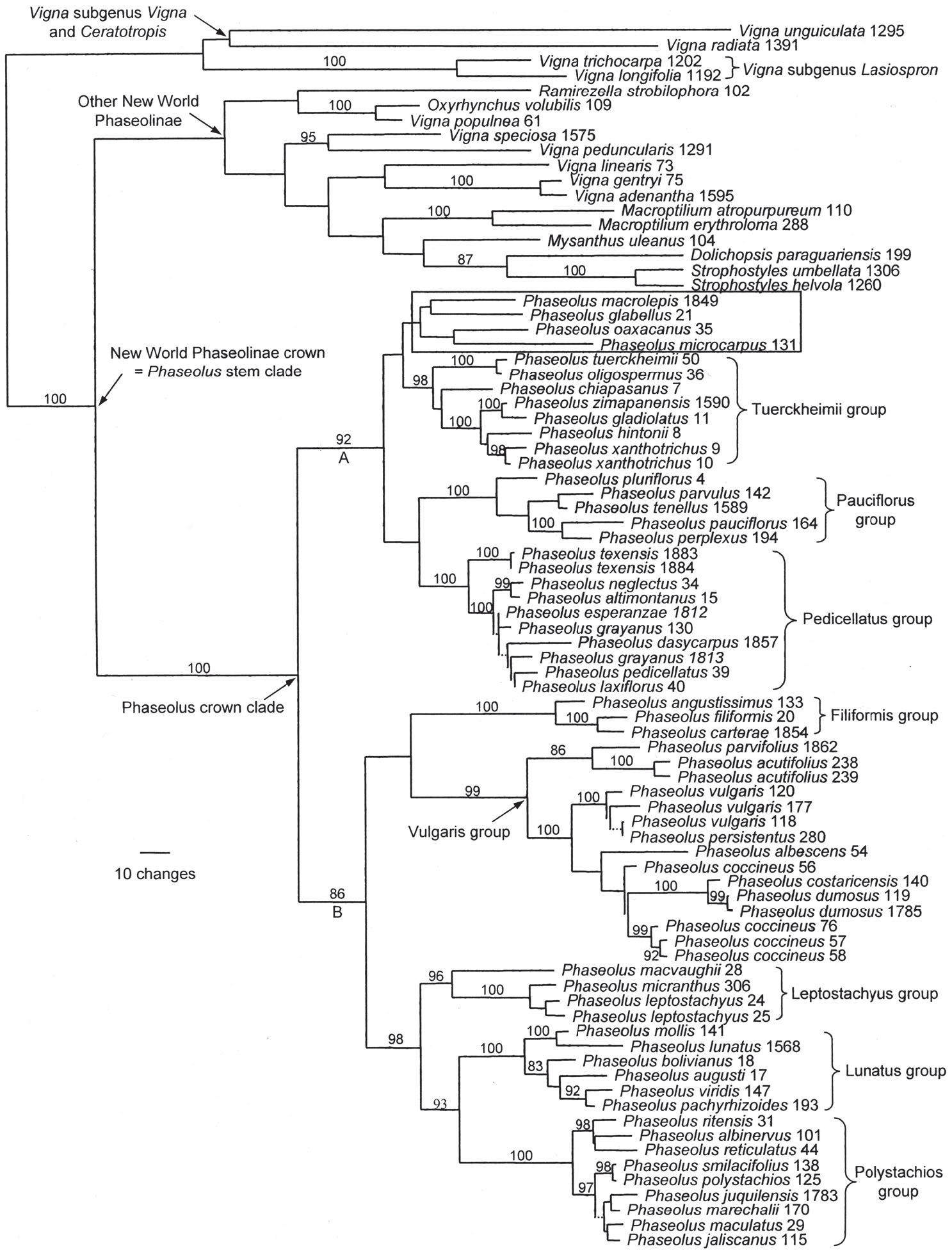
All 3 of these species are cross-compatible cuz they all belong to the same subgenus, especially Runner Bean x Common Bean is easier (Both in the section vulgaris), however Tepary Beans are in a different section (Still cross-compatible). Common beans are strongly self-crossing vs Runner Beans are more outcrossing, the only difficulty of course is working with tiny flowers that require dexterous fingers.
Here’s 2 Phaseolus phylogenic trees, there’s also SOOO many other wild Phaseolus species that we haven’t even begun to explore crossing/domesticating.
Just for some inspiration, look what the wild versions (Top layer) of our domesticated (Bottom Layer) species look like?
If it was done with these species, surely other wild species can have similar potential no?
It’s very interesting to me how Runner Beans & Lima Beans are the BIG beans of their relative subgenus. I think big beans are possible in many more species. Especially what’s interesting is how the tiniest wild Runner Beans became the Biggest domesticated Beans, both are the same species!
Phaseolus dumosus is of course a naturally occurring hybrid between P. vulgaris x P. coccineus, really it’s a species complex of the whole vulgaris section.
Crossing Lima beans into this mix is near impossible but I don’t want to discourage anyone from trying as It would be cool too!
I’ve got all of them included in the mainly vulgaris mixes I’ve grown.
I don’t do any specific hand pollinating, just include them to see what happens and maybe get that weird chance open pollinated cross of something. All are bush types.
Ooh! that is the exciting part about, seeing the cool surprising in the garden!
I hope to do some hand pollinating beans & get good at it.
Since runner beans are more outcrossing than common beans, you might find more hybrids in the runner beans side of your mixed population. Also it seems like Bush Runner Beans are rare, do they also make big edible tubers?
Bush runners are super hard to find. I think mine is the “hestia” variety. I have not seen any tubers, and none that survive past one season. They usually burn up when the weather gets hot & dry.
I’m always hoping. I’ve had some interesting second & third generation beans show up. I should probably take a closer look through everything.
Tepary beans have done really well some years they really struggle others. I think they like the hot and dry but maybe they struggle with the wetter years + my clay, or maybe just the humidity.
We actually had a weirdly cool summer this year, barely touched triple digits relative to normal.
Yeah, teparies hate the wet. Uncertain how they do with humidity (I’ve never successfully planted them in my new location) but at my old house they struggled until I stopped watering entirely. Soil was sand, high desert.
I’m afraid they don’t do well here, in my clay soil. Kansans think their environment is dry, but they have no idea what dry is. My drought adapted tomatoes didn’t even try. They took one look at the spring rains and said “nope.”
I bet P. vulgaris or P. coccineus x P. acutifolius would create the best adapted offspring for your texas climate. Take the more Humidity adapted traits of Common & Runner Beans to combine them with Heat Tolerant Tepary Beans.
Or… looking at some Vigna spp., you might find one that loves your climate.
Interesting, this gives an opportunity for common beans to thrive. This is why i like diversity, as many variety + species of legumes because Unexpected weather happens time to time & some kind of legume will love it.
, they should learn from the wild solanum growing in your area. If you are willing to graft tomatoes onto wild solanums (Like Black Nightshades, Bittersweet Nightshades, ect) or potatoes maybe they might survive drought conditions.
I wonder, has anyone done grafting with beans (Phaseolus spp.)? I wonder if it will also help make hybrids easier or at least facilitate some Horizontal Gene Flow?
Common beans actually do great for me in spring and fall. Especially now that I’ve selected out the best performing varieties and have a diverse adapted grex.
Oh, my original tomato population survived drought conditions just fine. They had a problem with too MUCH water. They died when planted out into saturated clay soil.
Fantastic! They do prefer temps between 45f to 80f which your springs & falls can provide. I think you got it down if you treat common beans as a spring/fall crop and save Vigna for summer crops.
Still tho Tepary x Common Bean may provide the right genetic combo to make a Phaseolus adapted to your humid but HOT texas climate.
Couldn’t handle too much water clogded soils.
Was there any Solanum that didn’t have this issue?
Not in that population group. 100% of my drought tolerant tomatoes died that first year, so I’m starting over. I have about a dozen that have survived this year but they weren’t from my drought tolerant population. Standard heirlooms, hybrids, and survivors from last year’s purchased plants. Two appear to be fruiting a lot, so they’ll be primary.
The mixed black solanum didn’t seem to have a problem, and I have 3 pepper survivors, two of which have fruited.
Ok, I think I’ll do primarily common as the female parent. I have 4 varieties of white beans so I am more likely to be able to identify crosses in the first generation. I don’t have any white tepary beans.
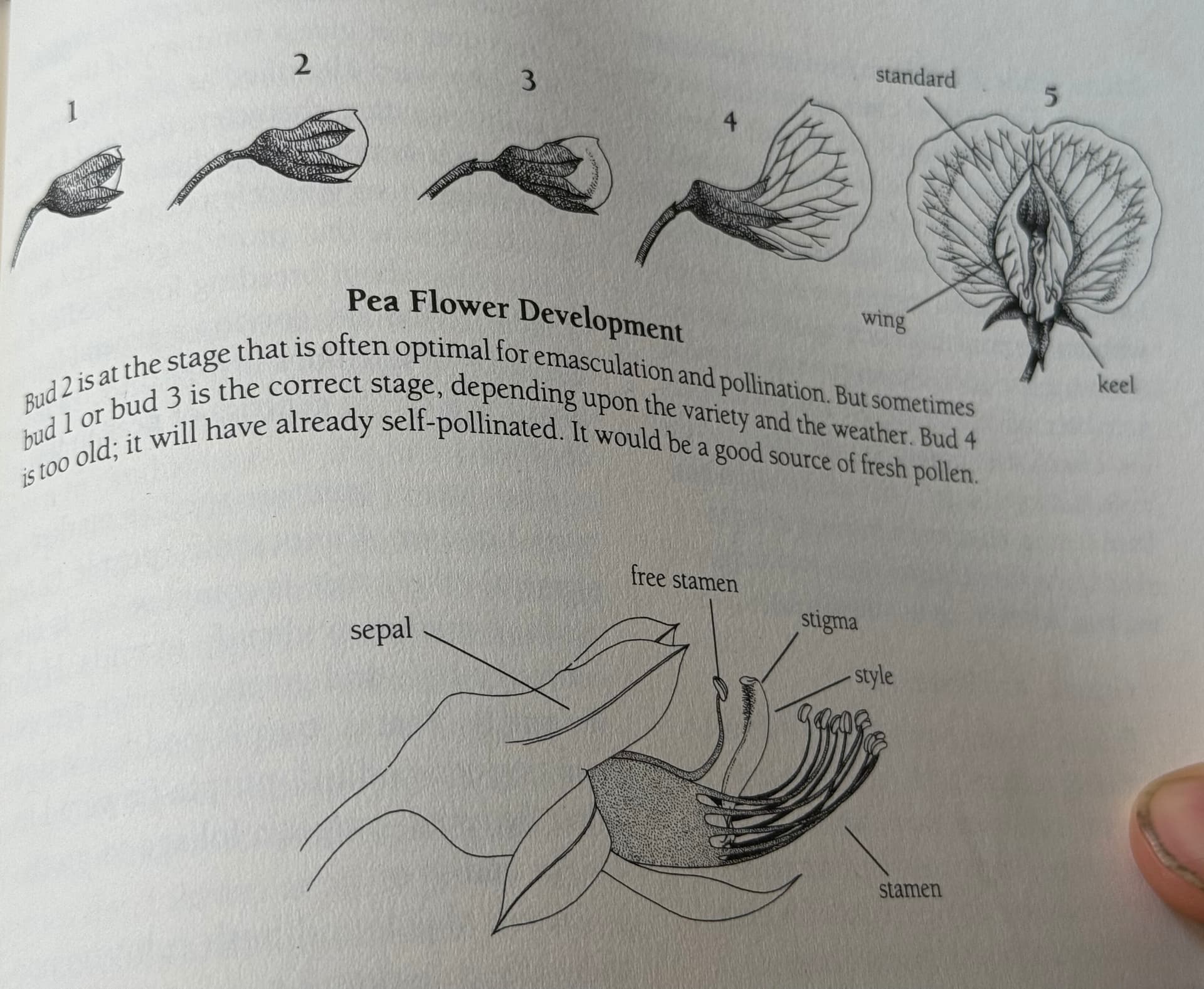
I have not attempted crossing beans, but here’s detailed description from Carol Deppe’s “Breed Your Own Vegetable Varieties”.
The illustration is from peas because the flower structure is simpler, but all of the anatomical parts and terms are the same. In beans, the stamens, styles, and stigmas are all coiled around each other, which makes both illustration and manual crossing more difficult (but not impossible!).
See Carol’s description of a fertile x fertile crossing method on the last page, which is less fiddly and might work well with your situation because it should be relatively easy to identify successful crosses in the next generation. It would be less certain to produce crosses, but you could do more of them with the same amount of effort.
Might be a good idea to try grafting Tomato scions onto Black Nightshades. It’s could horizontally transfer those adaptive genetics into the seeds of the next generation. Really weird/interesting things happen to the scions seeds when grafting.
Also if your tomatoes appear to be fruiting, might be a good idea to harvest some green and let ripen off the vine (As insurance in case the plant dies or an animals eats the ripe fruits), this way you won’t be left with no seeds.
It’s a bit complex, you have to pull the top & bottom parts apart.
Another possible approach is one I heard from Leighton Morrison of the “it’s all about the biology” on you tube, where you could pull up some of the thriving mixed black solanums and dunk them in a bucket of water and rinse out all the microbiology that is adapted to your environment and then share it with your tomatoes. It’s not gene transfer, but a microbiome assist that could help your tomato genes function better.
oooh! , that’s a good idea! It’s also possible that micro-biome transfer may also make it easier for Horizontal gene flow to happen.
As I understood the, good genetics + good soil life = Healthy Plant.
I also wonder if it’s just possible to grow tomatoes next to black nightshades? Won’t both microbiomes eventually meet when growing next to each other?
Sowing at different times can help sync up flowering times better. Pruning off early flowers to give other bean plants enough time to catch up is also useful.
I’m sure grafting can help this off-sync flowering issue (Might even help make interspecies cross more likely/successful & better faciliate HGT) but may not be necessary if the 1st 2 methods do the trick.
But why not combine them all

 yea texas heat ain’t no joke, I bet the Tepary Beans would do much better with that heat. This is why I want to cross them.
 , they should learn from the wild solanum growing in your area. If you are willing to graft tomatoes onto wild solanums (Like Black Nightshades, Bittersweet Nightshades, ect) or potatoes maybe they might survive drought conditions.


 , that’s a good idea! It’s also possible that micro-biome transfer may also make it easier for Horizontal gene flow to happen.