Uses of seed banks!

During our meeting in Croatia, we tried to make the most of some free time to talk with Thomas about our experience seed hunting at gene bank sites.

We didn’t have enough time to do it properly, but we promised to write a post with more detailed methodology.

The aim of this post is to ensure that every member of the group who was there has all the information. We hope that this information will be useful to all Going to Seed members, but also that other members will show us how to use the gene banks in their countries.

So, 3, 2, 1… let the seed hunt begin!

4 Likes

@marcela_v , @malterod, @Laura , @mare.silba , @Hugo , @ThomasPicard , @Bore , @Sebastien

Why use seed banks?
Quite simply because botanical institutes carry out important work in collecting and storing seeds. This material helps to preserve rare and sometimes extinct genetic material in the regions where it was collected.
Seed banks simply store this material and reproduce it as soon as possible, but they often lack the resources to preserve everything…and above all, we can use this incredible resource to create the adaptive varieties of tomorrow.

I will give you details of the one I use, namely the French INRA (National Institute for Agricultural Research) :

Foreword :

  • Applications must be submitted between October 1 and March 31.
  • The same accession can only be made once by the same person.
  • The quantity is standardized to 20 seeds per sample.
  • This database is accessible to everyone, including amateurs, free of charge for up to 10 varieties (accessions) per year. (requests that preparation and shipping costs (€15/accession) be covered for requests of more than 10 accessions per year, So let’s work as a network if we want to get a lot of people onto the property ladder in the same year.)
  • Please indicate here what you are publishing with the aim of sharing and working collectively. Given the limit of 10 request per year, it is best not to all ask the same stuffs.:wink:

User manual :

For those who want more details, you can find all the information here:

For those in a hurry, I recommend using the quick method I am showing you here:

1/Click on the flag in the top right corner to chose comfortable language

2/ Select the plant you want to search for varieties of from the icon

3/ Go to the bottom of the page and click on the number of managed accessions

2

4/ To avoid spending your life clicking through thousands of varieties, go to the blue banners

QUERIES on the left

and click on the SEARCH tab > accessions > passport

5

5/ To perform a multi-criteria search and eliminate varieties that do not interest you, check the boxes at the bottom of the page:

  • available

  • Then enter your search criteria…be careful not to enter too many, because if you leave some fields blank, your search will not find anything, but also be sure to enter at least a few, otherwise you will get the entire list, which can sometimes be several pages long.

6/ click on green button at the bottom right Results (wait please)

7/you get the list of your varieties with the selected criteria

8/you can click on the name of the variety to see if the other criteria for that variety suit you

9/ If you like this variety, add it to your cart

8

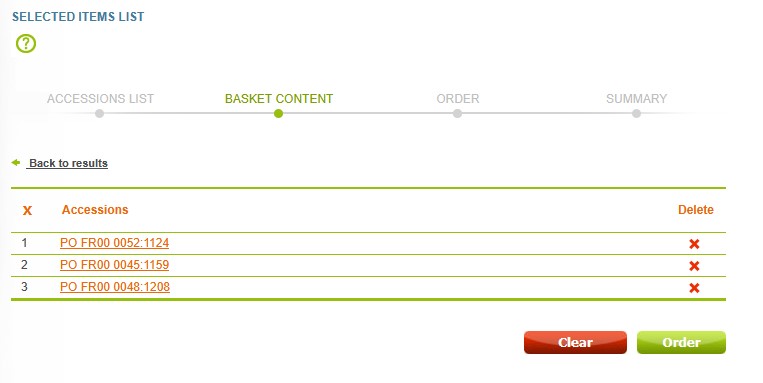
10/When you are finished, go to your shopping cart at the top left of the page

9

11/ click on Order

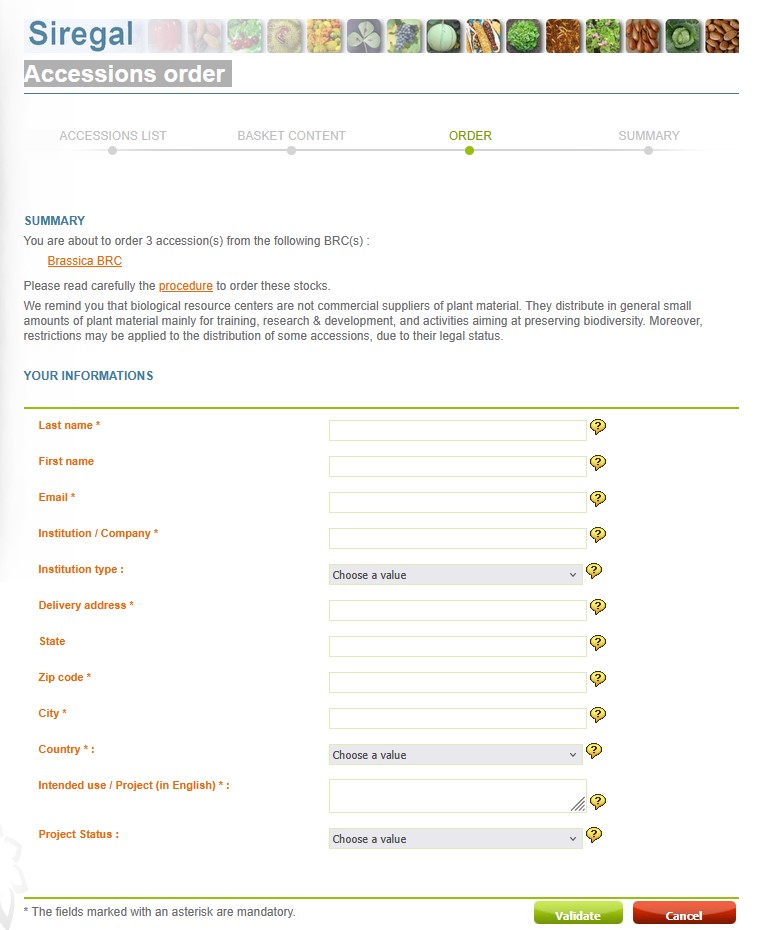
12/ fill out the Accessions order form, and click validate

13/ And from memory, because I can’t do it in practice, only in real life, it was finished or there is just one page left to validate.

14/ You will receive an email confirming your request and that the equipment is available…

15/ then a second email later when your file has been processed.

This email states:
”Following your order below, please find attached our terms and conditions and a material transfer agreement.

Please sign and scan this document in its ENTIRETY before returning it to us as a .pdf file so that we can prepare and send your samples.”

.

16/ Wait until you receive your seeds in the mail, sow them, multiply them…and above all, share them.

:partying_face: :partying_face::partying_face:

7 Likes

Thank you for that Stephane, that was very instructive. I have some questions you or another member of this community might be able to answer.

Can people from outside France apply for INRAE seeds? Did you single it out because it has many variety seeds or because you know how to use it?

Can i apply for seeds from any seedbank?

Are the rules fairly similar among seedbanks that it’s free up to a certain amount?

Off topic question/proposal/train of thought. If we would, for the sake of argument take rootnoding Maxima’s as an example. If we would (which we don’t because it’s too nerdy) chose at some point in future together decide on selecting for that trait would bring seeds together from all seedbanks we can access for that trait. Grow them out and then combine them after a season into a European Super (Noding) grex. Or is this already commonplace amongst universities and professional seed companies? But imagine we create such super noding grex and the year after do similar for another trait. We create a super zero input grex and then a super early start grex. And then combine these and spread them to people who have it the worst , like mountain growers… i know we kind of do this already by mixing genetics, but as we seem to have this tool at the tips of our fingers which connects us to very rare genetics, shouldn’t we use it the way i describe above? Or is that just way too ambitious at this point in time? Too nerdy/ idealistic.. Whaddayathink?

(Trait : rooting at each node for squashes)

Hi Hugo, this trait just doesn’t exist in seed banks, not at all. And on a side note everything is grown on plastic tarps for 50 years so you have zero chance them identifying that trait now and in following years.

You have to consider seed banks as (boring) databases with “some” data you have to go through : each datapoint costs some money to the seed bank because behind each data point you got someone spending time on it. And they ALL seed banks complain about lack of funding, of employee shortage.

So you’ll have to look for a trait tangential to what you are specifically looking for : for example when I was looking into INRAE databases couple years ago I wanted to find crazy root structures and vigor in cereal for my cover crop, so looking into 30000 accessions. Nothing was named “root structures” or “vigor”, so I had to look tangentially and looked at the criteria : there was a 1 to 5 index of growing habit and 3 different scales of height at flowering, scaled one from1 to 5, one from 1 to 7, and another expressed in centimeters. Also consider that dome data is missing in nearly all accessions. But so I combined both : growth habit n1 (prostrate, so in my mind covering the soil) and height n5, n7 or above 200cm for rye (so the tallest). And so after a couple hours of efforts I ended up with a shortlist of accessions corresponding to those tangential traits.

Scroll down those databases and you’ll see.

Still there was a lot to be done in the field and I could throw to the bin 75% of the accessions after a growing season : not at all corresponding to what I wanted. For example there was some spring rye mixed up with winter rye. Not named as such, and so dying miserably.

But on the other hand, if you know people in those seed banks they may help you directly, looking for those particular traits you are asking for, demanding a special effort from them. But being underfunded means it’s not easy for them in general to agree doing some supplementary work. You’ll have to be friends, somehow. Or they really get your interest and that makes sense to them.

Databases are mostly about fruit traits so good luck finding anything related to vigor or anything related to soil/plant interactions, biology, that would express a potential of adaptation. So yes your overall idea is not realistic considering those databases.

Only hope would be if you had friends working in the seed banks, or that you would be in the know of breeders, or cucurbit collectors and you would say to them something that would trigger their interest in that trait. Overwise it’s a no go.

I’ll do a specific recap on IPK-Gatersleben which is the website with all European seed banks.

For those in a hurry I’ve already done it here: Where to get Wild Tomato Genetics! - #12 by ThomasPicard and in another topic related to kiwano

2 Likes

One very important thing I forgot to mention: by signing the paper contract sent by email, you agree not to patent the genetic material and not to distribute it. However, you may distribute its modified offspring after hybridization, for example. :wink:

People residing outside France and European citizens can access it just like French citizens. For members outside Europe, I’m not sure, but the easiest thing would be to try it and let us know. Perhaps there are shipping costs involved?

Normally, all European seed banks are linked, and we can use them as members of the European Union.. @ThomasPicard will post here so we can consult the European seed bank database. My question is also yours : does anyone know if I can request genetic material from another continent, and if so, on which online platform?

As for whether they’re all free, I have no idea…it’s up to us to test them out.

I used and showed the INRAE platform because it is the one for the country where I live, so I haven’t explored any further yet. But I hope that here we will learn how to use other, more distant platforms to find other genetics and, above all, other plants that are not available on INRAE… I am counting on the community to teach us.

For your squash project, on paper it’s a good idea… but in reality it’s going to be difficult because when you look at the variety sheets you’ll quickly realize that sometimes only the name of the variety and its country of origin are known… the dream would be to have all the information on the criteria needed to create great grexes… but this painstaking work will never be done because it’s such a colossal task… .
Perhaps this is possible with other banks, but in any case not in France, where we don’t have enough resources to satisfy our grand ambitions…

2 Likes

Thanks a lot for your extensive reply Thomas. That totally makes sense.

So if we somehow, like you already did, put in the work and scan through the ‘secret coding’ we might end up with some quarter of crops that more or less respond to those traits we’re looking for on the extreme end of the spectrum. I have to say don’t find that encouraging, but not that discouraging either seen as the rewards can be very good.

2 Likes

This is the other post I did made with Eurisco screenshots (= IPK-Gatersleben database of all European seedbanks). About Kiwano.

I’ll do a more comprehensive recap later - and we’ll condense Stephane’s and I’s presentations in a pdf - but the little nugget in that one is that there is a code for landraces : it’s “300” in the SAMPSTAT column of Eurisco.

The ladies from “D’une Graine aux Autres” non profit (facebook, podcast) taught us that in a webinar 2 years ago : as they are doing modern landracing in broadacre crops mostly with an organic mindset they absolutely want not to mess around with all the traffics made with seeds since the 70s, so they only use “landraces” - all collected before that - as “ingredients” of their PEPS (they coined the acronym), before adoption by farmers.

Those who were in Antibes will remember their long process of studying the crops in the field and doing seed increase before doing any kind of mixes for known purposes. They would explain that “when you get accessions out of seedbanks you still have to study them”, in other words : data’s lacking. Nonetheless the code 300 may be interesting to some.

Link to their intervention in French here : https://youtu.be/6ztQKr7h-GE?feature=shared

1 Like

@ThomasPicard , when you have some time, please try to write up some instructions for using Eurisco so that we can request more seeds… because certain species are not available from the French bank.

ok but until then people can go to prior posts on Eurisco : I won’t add a lot to it.

This was another detailed report with (nearly) all we need to know to ask for accessions in National seedbanks, using the Eurisco portal :

1 Like